Background
Rudd is an invasive fish native to Europe that has been found in scattered locations in the lower Great Lakes. A member of the minnow family, the fish was introduced to the United States in the early 20th century, likely through the bait trade. Rudd are often found in waters that are still or slow moving, with thick vegetation. They can adapt to a wide range of freshwater habitats and can tolerate poor water quality. Adult Rudd eat both aquatic plants and insects, while young Rudd feed on algae and small invertebrates such as snails, insects, and worms.
Range
Rudd were first found in Ontario in 1990 in the St. Lawrence River. In 1997, Rudd were discovered in western Lake Ontario and eastern Lake Erie. Rudd has never been found in an inland lake in Ontario, to date. Other than Lake Ontario and Lake Erie, Rudd has also been introduced to more than 20 American states.
For an up to date distribution map of Rudd in Ontario, visit www.EDDMapS.org/distribution.
Impacts of Rudd
More research is needed to determine the impacts of Rudd on native species in North America. However, scientists are concerned about the long-term effects of the Rudd’s breeding habits and diet.
- Rudd are able to breed with the native Golden Shiner (Notemigonus crysoleucas), an important baitfish. The offspring are hybrids and are considered invasive, which could lead to a loss of genetic diversity in the population of Golden Shiners.
- Juvenile Rudd compete with native species for their habitat and food, such as algae and small invertebrates.
- Adult Rudd can eat large amounts of aquatic plants along shorelines, which can degrade spawning and nursery habitat for native fish, such as Northern Pike, Muskellunge, and Yellow Perch.
To prevent this unwanted invader from expanding its range in Ontario, the province has banned the possession and sale of live Rudd and other invasive fish species.
How to Identify Rudd
- The Rudd is a relatively large, deep-bodied minnow with a small, upturned mouth.
- Adult Rudd are 10 – 25 cm (4 – 10 in) long. The largest Rudd found in Ontario was 38.5 cm (15 in) long.
- Adult Rudd resemble native Golden Shiners, with a few slight differences.
Check the chart below to know if you have a Rudd or a Golden Shiner.
INVASIVE
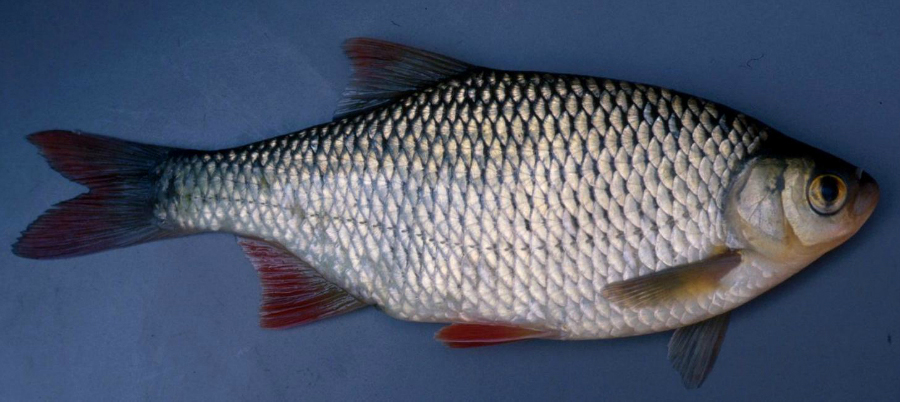
Rudd
(Scardinius erythrophthalmus)
Details
- Fins are bright red
- Fully scaled belly (keel)
- Eyes are red or have a red spot
NATIVE
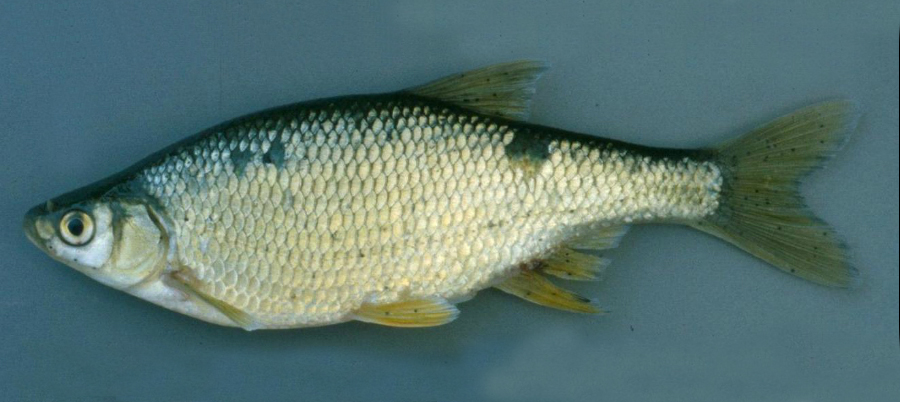
Golden Shiner
(Notemigonus crysoleucas)
Details
- Fins are yellow-green (except in spawning adults). Breeding males have red-orange anal fin with a black outline
- No scales on belly (keel)
- Eyes are yellow-green
What You Can Do
- Learn how to identify Rudd and how to prevent the spread of this unwanted species.
- Never buy or keep live Rudd. It’s against the law to keep live Rudd or other invasive fish.
- Don’t release any live fish into Ontario lakes, rivers, or streams. Return or donate unwanted aquarium fish to a pet store or local school.
- If you have any information about the illegal importation, distribution, or sale of live Rudd, report it immediately to the MNRF at 1-877-847-7667, toll-free any time. You can also call Crime Stoppers anonymously at 1-800-222-TIPS (8477).
- If you’ve seen a Rudd or another invasive species in the wild, please contact the toll-free Invading Species Hotline at 1-800-563-7711, visit EDDMapS, or search for the ‘Invasive Species in Ontario’ project on iNaturalist.org to report a sighting.
Gallery
OFAH/OMNRF Invading Species Awareness Program. (2021). Rudd. Retrieved from: www.invadingspecies.com.
This factsheet may be reproduced for non-commercial purposes.
Header photo by Brian Gratwicke | Fish photos by John Lyons
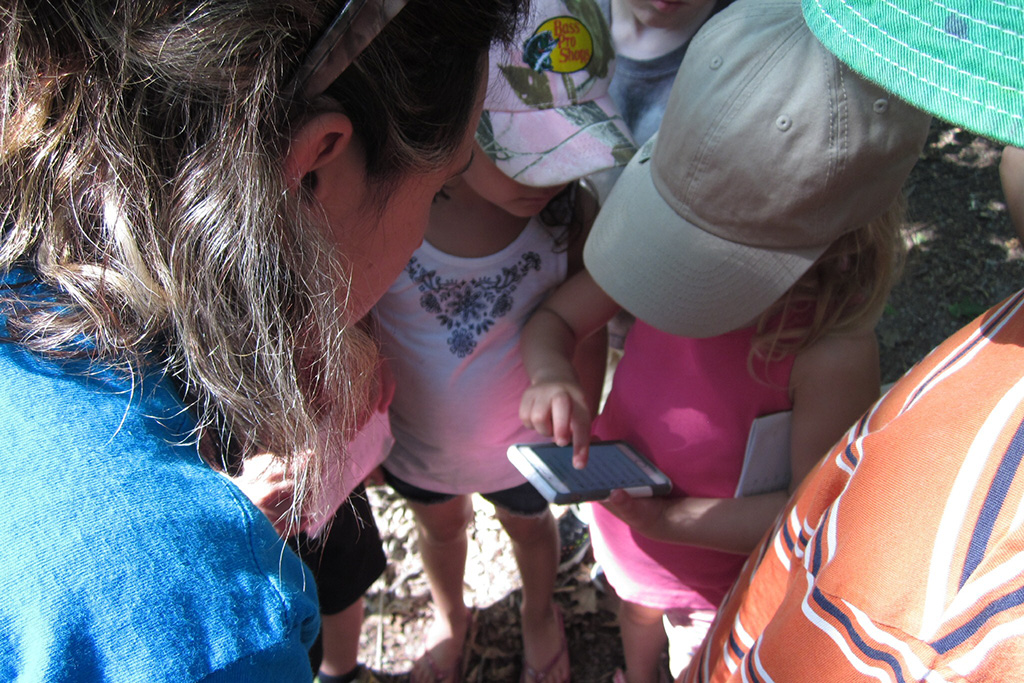
Think you have seen an invasive species?
Report it!
Invading Species Hotline
1-800-563-7711